
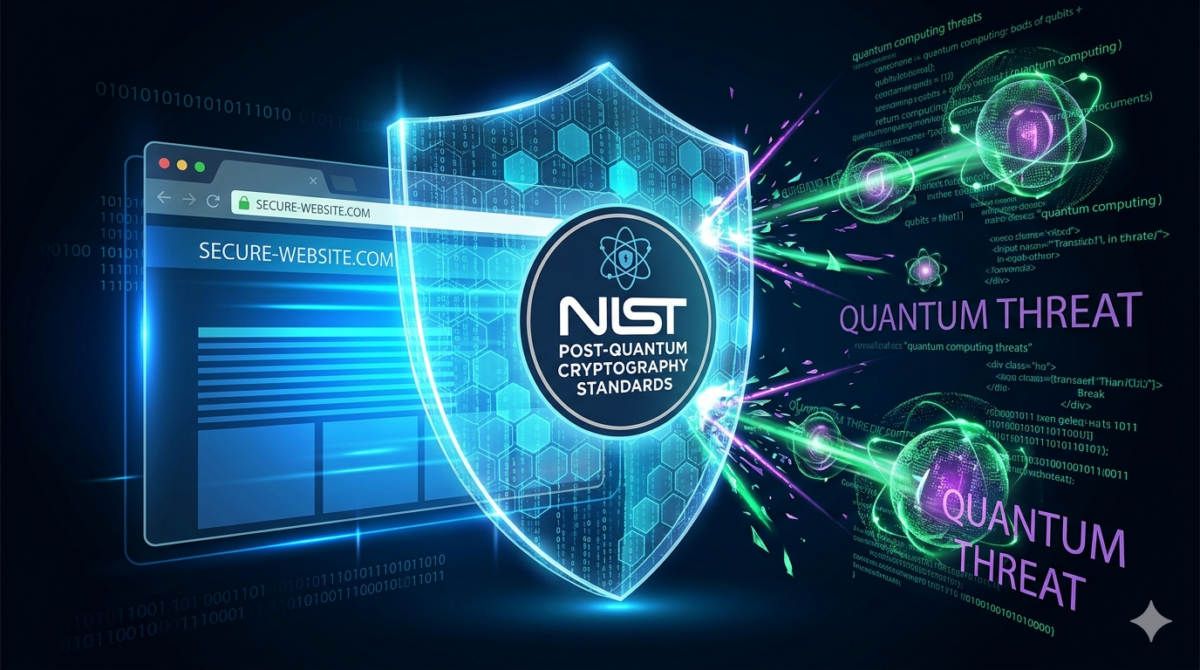
If you manage a website, you likely rely on an SSL certificate to protect your visitors’ data. That certificate uses encryption algorithms — most commonly RSA or elliptic-curve cryptography (ECC) — to establish secure connections between browsers and your server. But there is a new threat on the horizon that could render those very same certificates vulnerable: the quantum computer.
The good news is that the transition to post-quantum encryption has already begun. In August 2024, the U.S. National Institute of Standards and Technology (NIST) released the first three finalized post-quantum cryptography standards. By March 2025, a fourth algorithm was selected as a backup key-encapsulation mechanism. For website owners and hosting customers, these developments are not distant theory — they are actionable reality that deserves attention now.
What Is Post-Quantum Encryption?
Post-quantum encryption refers to cryptographic algorithms designed to remain secure even against attacks from powerful quantum computers. Unlike classical computers, which process information in bits that are either 0 or 1, quantum computers use quantum bits, or qubits, that can exist in multiple states simultaneously. This capability allows them to solve certain mathematical problems exponentially faster than classical machines.
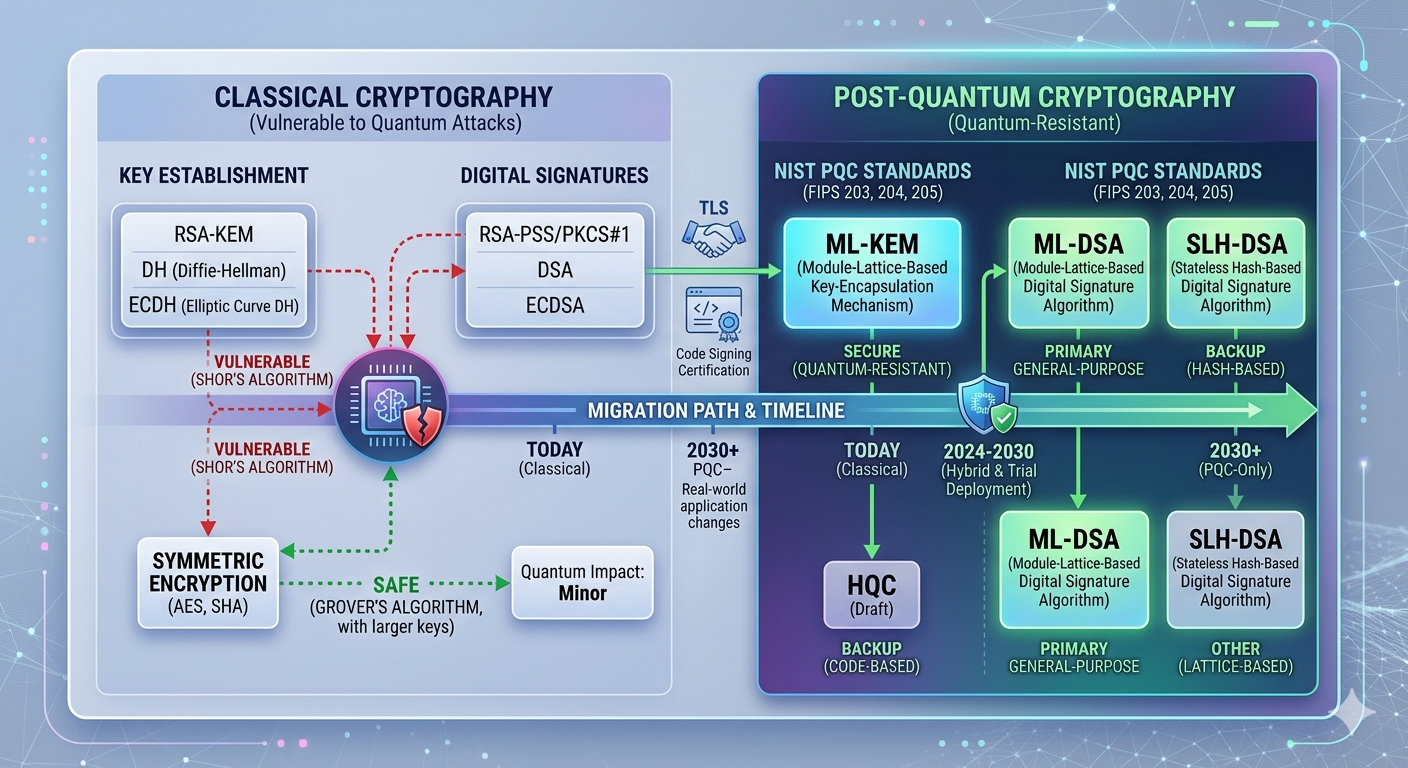
The specific threat to SSL certificates comes from Shor’s algorithm , a quantum algorithm that can efficiently factor large integers and compute discrete logarithms — the two mathematical problems that RSA and ECC encryption rely on for security. A sufficiently powerful quantum computer running Shor’s algorithm could, in theory, break RSA and ECC encryption and impersonate any website, including yours.
While no quantum computer capable of breaking current encryption exists today, cryptographers are not waiting for that day to arrive. The risk model known as “harvest now, decrypt later” describes attackers who intercept and store encrypted data today, planning to decrypt it once quantum computers become powerful enough. For websites handling sensitive customer information, this is a genuine concern.
The NIST Post-Quantum Standards You Should Know About
NIST has been running a global competition since 2016 to identify and standardize post-quantum cryptographic algorithms. The results have now moved from research papers into official federal standards, and they are already shaping the future of web security.
FIPS 203: ML-KEM (Module-Lattice-Based Key-Encapsulation Mechanism)
Previously known as CRYSTALS-Kyber, ML-KEM is the primary standard for key encapsulation — the process by which two parties establish a shared secret key over an insecure channel. This is the algorithm that will form the foundation of quantum-resistant key exchange in TLS connections. ML-KEM is based on lattice mathematics, a field of mathematics that remains resistant to both classical and quantum attacks. Its key sizes are relatively compact, making it well-suited for deployment in web protocols where bandwidth and latency matter.
ML-KEM was published as a Federal Information Processing Standard on August 13, 2024, following years of rigorous analysis by cryptographers worldwide. Its selection was based on a combination of security margin, performance, and implementation flexibility.
FIPS 204: ML-DSA (Module-Lattice-Based Digital Signature Algorithm)
Also derived from CRYSTALS-Dilithium, ML-DSA is the primary standard for digital signatures. SSL certificates are, at their core, digital signatures issued by trusted certificate authorities. When a certificate authority signs your SSL certificate, it uses a signature algorithm to prove authenticity. ML-DSA provides the post-quantum replacement for the ECDSA and EdDSA signature algorithms currently used in most SSL certificates.
Like ML-KEM, ML-DSA is lattice-based and offers strong security guarantees with practical key and signature sizes that can be integrated into existing certificate infrastructure.
FIPS 205: SLH-DSA (Stateless Hash-Based Digital Signature Algorithm)
Based on the SPHINCS+ algorithm, SLH-DSA provides an alternative signature scheme that relies on hash functions rather than lattice mathematics. This diversity is intentional — having multiple algorithmic approaches ensures that if a vulnerability is discovered in one family of post-quantum algorithms, others remain available. SLH-DSA is designed as a backup to ML-DSA and uses a different mathematical foundation, making it an important part of a defense-in-depth strategy for certificate authorities.
FIPS 206: FN-DSA (FFT over NTRU-Lattice-Based Digital Signature Algorithm)
Built around the FALCON algorithm, FN-DSA is expected to be published as FIPS 206 in the near future. It offers smaller signature sizes compared to ML-DSA, which can be advantageous in environments with strict bandwidth constraints. While not yet finalized, its imminent publication means certificate authorities should begin planning for its integration.
HQC: The Backup Key-Encapsulation Mechanism
On March 11, 2025, NIST selected Hamming Quasi-Cyclic (HQC) as a backup key-encapsulation mechanism to complement ML-KEM. Unlike the lattice-based ML-KEM, HQC is code-based, relying on error-correcting codes for its security. This provides algorithmic diversity — if a theoretical weakness is ever found in lattice-based cryptography, HQC offers a proven alternative for quantum-safe key exchange.
What This Means for Your SSL Certificate
The arrival of post-quantum standards does not mean your current SSL certificate is immediately broken. Today’s quantum computers lack the processing power to break RSA or ECC encryption. However, the timeline for migration matters because of the “harvest now, decrypt later” threat and the time it takes to issue and deploy new certificates at scale.
Certificate Authorities Are Already Planning
Major certificate authorities are actively researching and testing post-quantum certificate formats. The transition will not happen overnight — it requires updates to certificate formats, validation processes, browser support, and server software. But the groundwork is being laid now, and website owners who stay informed will be better positioned when the transition becomes operational.
Hybrid TLS Connections Are the Near-Term Solution
The most practical approach in the near term is hybrid TLS , where both classical and post-quantum algorithms are used simultaneously during the key exchange. This means that even if one algorithm family is compromised, the other continues to protect the connection. Google has already conducted large-scale experiments with hybrid TLS connections using ML-KEM, demonstrating that the technology is viable and that performance impacts are manageable on modern hosting infrastructure.
What Hosting Customers Should Do Now
As a BuyHTTP hosting customer, there are several steps you can take to prepare for the post-quantum transition:
- Stay current with server software updates. Web servers like NGINX, Apache, and LiteSpeed are already integrating post-quantum cryptographic libraries. Keeping your server software up to date ensures you are ready when post-quantum TLS becomes widely available.
- Monitor your certificate authority’s roadmap. Check with your CA about their plans for post-quantum certificates. Some are already offering hybrid certificates that combine classical and post-quantum algorithms.
- Review your data sensitivity. If your website collects and stores sensitive customer data — personal information, financial records, health data — the “harvest now, decrypt later” threat is most relevant to you. Prioritize planning for post-quantum encryption if your data needs long-term confidentiality.
- Ensure your PHP and application stack supports modern cryptography. PHP 8.2 and later include improved support for modern cryptographic functions. Make sure your hosting environment is running a recent version.
- Consider a staging environment for testing. If your BuyHTTP plan includes staging, use it to test how your website performs with updated TLS configurations and post-quantum cryptographic libraries.
Understanding the Timeline
The migration to post-quantum encryption is a multi-year process. Here is a general timeline of what to expect:
- 2024-2025: NIST finalizes core standards. Certificate authorities and browser vendors begin research and internal testing of post-quantum certificate formats.
- 2025-2026: Early hybrid TLS deployments begin. Some certificate authorities offer optional post-quantum-enhanced certificates. Major browsers add experimental support for post-quantum key exchange algorithms.
- 2026-2028: Wider adoption of hybrid TLS. Post-quantum algorithms become standard in server software like OpenSSL, NGINX, and Apache. Certificate authorities begin recommending post-quantum certificates for high-security applications.
- 2028-2030: Post-quantum certificates become the default option. Classical-only certificates may be deprecated for new issuances. Website owners are strongly encouraged to migrate to post-quantum-ready certificates.
Why This Matters for Every Website Owner
You might be wondering whether post-quantum encryption is relevant to your small business website or personal blog. The answer is yes, and here is why.
First, the “harvest now, decrypt later” threat is not hypothetical. Intelligence agencies and organized cybercriminal groups are already collecting encrypted data from websites around the world, storing it for future decryption. If your website handles customer emails, contact forms, login credentials, or any personal information, that data could be at risk.
Second, the transition to post-quantum encryption will require action from website owners. Just as you updated your website when transitioning from HTTP to HTTPS, you will need to take steps when post-quantum certificates become mainstream. Starting your planning early gives you time to prepare your hosting environment, test configurations, and migrate without rushing.
Third, being proactive about post-quantum encryption is a strong signal to your visitors that you take their security seriously. In an era where data breaches make headlines regularly, demonstrating a commitment to cutting-edge security practices can differentiate your business and build trust with your audience.
BuyHTTP and Post-Quantum Readiness
At BuyHTTP, we monitor all major developments in web security and cryptography to ensure our hosting infrastructure is prepared for the post-quantum era. Our cPanel-managed hosting plans support the latest versions of PHP, NGINX, Apache, and LiteSpeed, all of which are actively integrating post-quantum cryptographic libraries through OpenSSL and other cryptographic frameworks.
As post-quantum certificates become available, we will work with our certificate authority partners to ensure our customers can easily obtain and deploy quantum-resistant SSL certificates. Our team stays current with NIST standards, TLS protocol updates, and industry best practices so you can focus on running your business.
Final Thoughts
Post-quantum encryption is no longer a theoretical concept discussed only in academic circles. With NIST’s finalized standards and the early stages of hybrid TLS deployment, the transition to quantum-safe web security is underway. For website owners, the key takeaway is simple: start learning, start planning, and stay informed.
The cryptographic algorithms protecting your SSL certificate today are the same ones that secured the internet for decades. They will continue to provide strong protection for the foreseeable future. But the smartest website owners are already preparing for the next evolution in web security — one that will keep their visitors’ data safe in a quantum-powered world.
At BuyHTTP, we are committed to helping our customers navigate this transition smoothly. Whether you are running a WordPress blog, an eCommerce store, or a custom web application on our shared hosting, VPS, or cloud hosting plans, we will ensure your infrastructure is ready for the post-quantum era.
Stay tuned to our blog for more updates on web security, hosting best practices, and the technologies that keep your website safe and performant.
Sources and Further Reading
- NIST Releases First 3 Finalized Post-Quantum Encryption Standards — NIST
- NIST Selects HQC as Fifth Algorithm for Post-Quantum Encryption — NIST
- Post-Quantum Cryptography Standardization — NIST CSRC
- Federal Information Processing Standards (FIPS) — NIST
- CRYSTALS-Kyber and CRYSTALS-Dilithium — Post-Quantum Cryptography Project
- Post-Quantum Cryptography — Wikipedia
Categories